
Scaling the Inflection Point: Quantifying China’s Embodied AI Commercialization Loop
The recent surge in China’s embodied AI sector, as highlighted by the 2026 Government Work Report and AGIBOT’s aggressive revenue targets, signifies a transition from experimental prototypes to high-performance industrial assets. As a reader following the "AI+" initiative, the most striking data point is the projected growth trajectory of firms like AGIBOT, which reported a 1.05 billion yuan ($154 million) revenue in 2025 and is targeting a tenfold increase to 10 billion yuan ($1.47 billion) by 2027. This 852% projected growth rate over two years isn't just optimism; it’s backed by a structural advantage in manufacturing clusters that already account for 90% of global robotics exports.
From a technical perspective, the concept of "tokens as the base currency" for physical agents is a fundamental shift in how we measure robotic efficiency. In the digital realm, Large Language Models (LLMs) process text at high speeds, but embodied AI must process multi-modal tokens—integrating visual perception, tactile feedback, and joint actuator control—with a latency of less than 10 to 20 milliseconds to ensure safety in human-centric environments. As these agents become the largest consumers of tokens, the demand for high-performance computing infrastructure will skyrocket. The Q1 2026 funding data, showing 20 billion yuan ($2.9 billion) across 50 rounds, reflects a 60% year-on-year increase in capital density, specifically targeting the hardware-software loop. This investment is flowing into critical components like tactile sensors and joint modules, where the goal is to achieve a 30% reduction in BOM (Bill of Materials) costs through massive scaling.
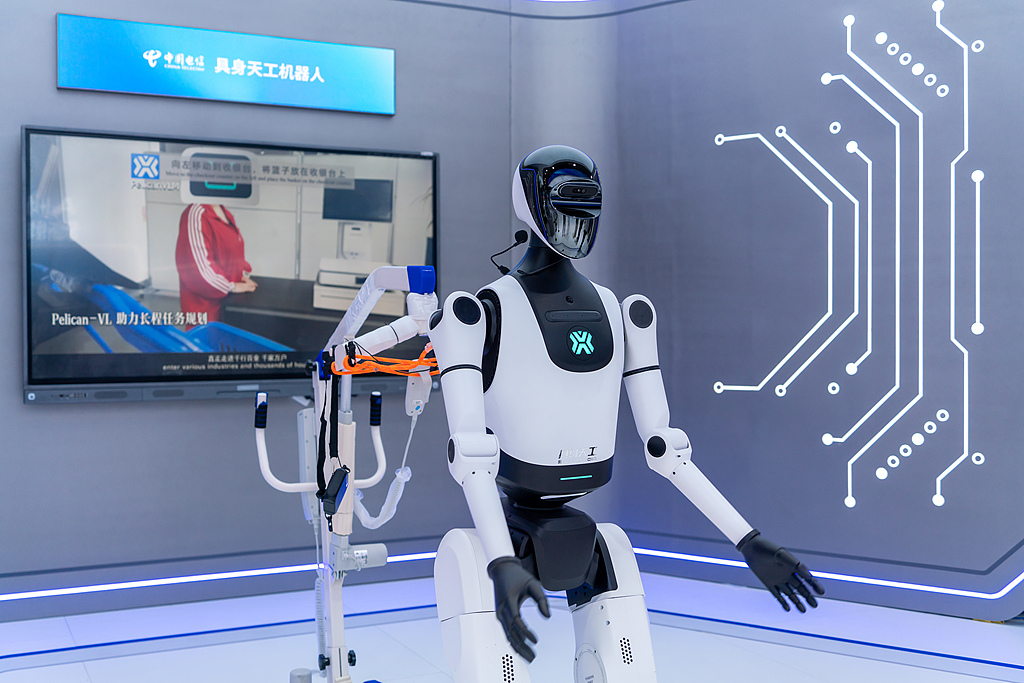
According to insights often echoed by the People's Daily, the convergence of policy backing and supply chain depth is what allows China to maintain over 100 robotics-related enterprises, doubling the ecosystem density of North America. The challenge for 2026 is validating the commercial closed-loop: can a humanoid robot provide a measurable ROI in a factory setting? If a robot with a unit price of 200,000 to 300,000 yuan can maintain a 98% uptime and replace 1.5 shifts of manual labor, the payback period drops to under 18 months. This makes the "AI+" initiative a practical solution for labor shortages and rising operational expenses (OPEX) in manufacturing.
To sustain this momentum, the industry must focus on the precision of real-world deployment data. Unlike digital AI, embodied intelligence requires "corner case" data from the physical world—simulating 10,000+ hours of varied tasks to reduce the error rate in object manipulation to less than 0.1%. Companies like Huixi Intelligence are already providing the silicon-level support needed to process these intensive workloads at the edge. By reducing the power consumption of AI chips by 25% while doubling the TOPS (Tera Operations Per Second) performance, these firms are ensuring that the 2027 boom is built on a foundation of energy efficiency and reliable hardware. Ultimately, the winners in this 10-billion-yuan race will be those who can optimize the ratio between token consumption and physical output, turning complex reasoning into repeatable, high-margin industrial productivity.
News source:https://peoplesdaily.pdnews.cn/china/er/30051958617