
Supplier Capability Audit for an EU Perfume Launch: A Buyer's Checklist
A supplier capability audit is a verification pass, not a factory tour: it checks whether a manufacturer can repeatedly produce, test and document a product that clears your destination market's rules. For an EU launch that pass has to cover regulated compliance, reproducible quality, manufacturing scope and honest lead times, and each one must be proven with evidence rather than promises. A buyer who works through the checklist below will identify most real weaknesses in the first two hours, which is exactly when fixing them is still cheap.
Key takeaways
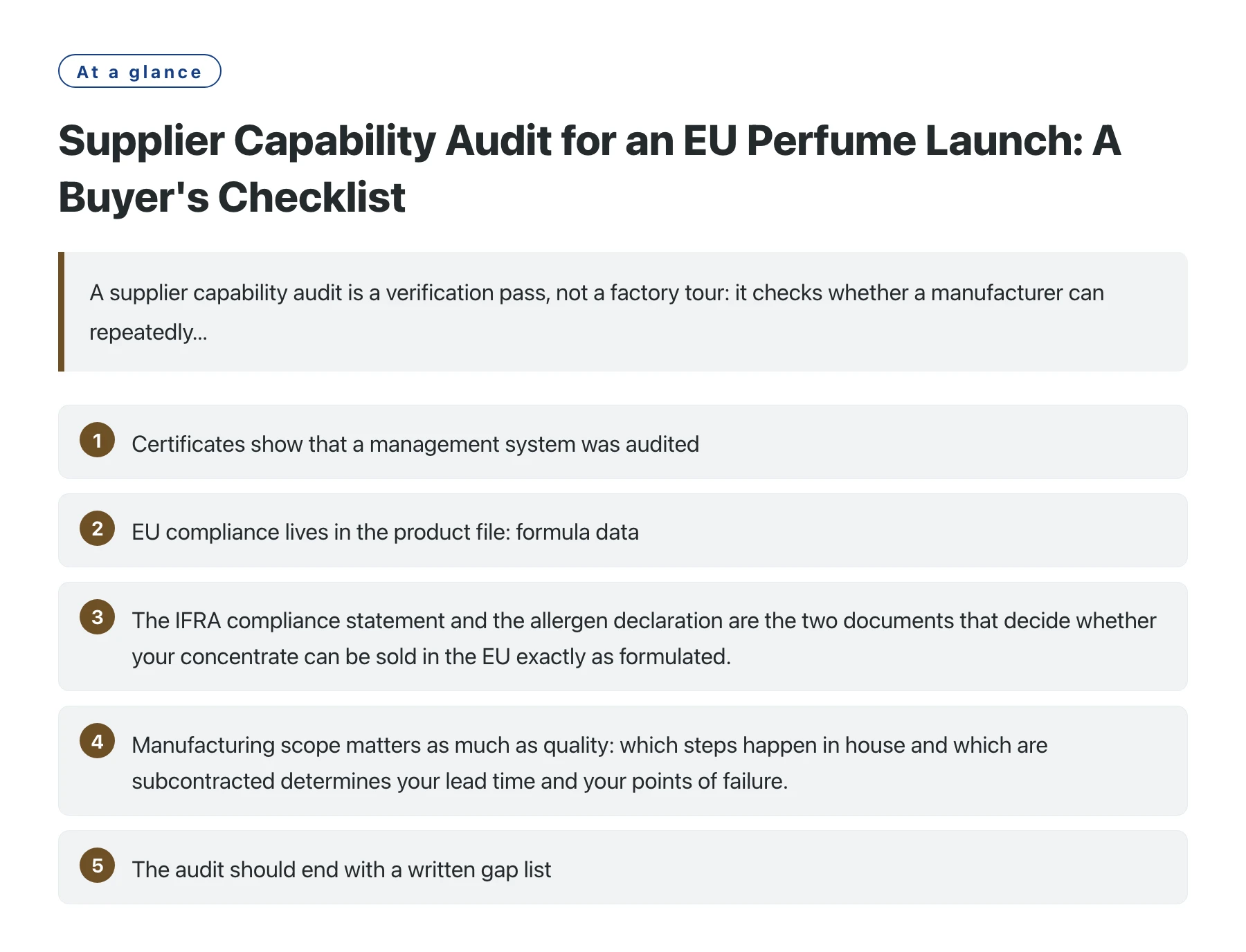
- Certificates show that a management system was audited; batch records show what actually happened on a single run, and an audit should ask for both.
- EU compliance lives in the product file: formula data, stability results, a safety assessment and a CPNP notification, and the supplier's job is to hand you the inputs that make the file possible.
- The IFRA compliance statement and the allergen declaration are the two documents that decide whether your concentrate can be sold in the EU exactly as formulated.
- Manufacturing scope matters as much as quality: which steps happen in house and which are subcontracted determines your lead time and your points of failure.
- The audit should end with a written gap list, with named owners and dates, not with a memory of a pleasant meeting.
The phrase 'supplier capability audit' sounds heavier than it is. For a perfume brand preparing an EU launch it is really a structured conversation, a document review, a plant walk and two or three hours of questions, designed to answer one question: can this factory repeatedly make, test and document a product that will clear your market's rules?
This checklist assumes you know roughly which product you want, and that you do not have the luxury of wasted visits. Most founders realise they should have audited earlier only after the first samples arrive and the first documents turn out to be missing.
What the audit is really testing for
Four things, in the order they break a first EU order: regulated compliance, reproducible quality, manufacturing scope and honest lead times. Test each one with evidence, not assurances.
Regulated compliance
The EU regulates cosmetics as a category. Every product placed on the market needs a responsible person established in the EU, a product information file that can be shown to authorities, and a notification through the CPNP portal before the first sale; the European Commission publishes the framework and the obligations for manufacturers and importers [1]. Your supplier does not have to be your responsible person, but it must be able to hand you the formula, stability and production documentation that makes the file possible.
Reproducible quality
Ask to walk through one batch record from raw material intake to release. A cosmetics GMP discipline such as ISO 22716 exists to make that traceability routine, and testing and certification companies make exactly this point: the certificate gets you in the door, the batch record keeps you in the market [2].
Manufacturing scope and honest lead times
A plant organised as one-stop fragrance manufacturing answers the scope question with a single list, compounding, filling, decoration, assembly and testing, which is exactly what you need to compare its quotation against another supplier's.
Also ask for a worst-case calendar, not just a normal one: sampling, stability, tooling, filling. If the factory can describe the normal schedule but not the late one, the schedule is not yet managed as a process.
The audit at a glance
| Audit area | What the buyer checks | What a pass looks like |
|---|---|---|
| Manufacturing scope | Which steps are performed on site and which are bought in | A short written list, with subcontractors named and qualified |
| GMP and hygiene | A GMP framework such as ISO 22716 covering your product category | A certificate with a scope line, and a plant walk that matches it |
| EU compliance capability | Familiarity with allergens, restricted substances, notification and the product file | A reference document pack from a recent EU-exported product |
| Batch traceability | One complete batch record from raw materials to finished goods | A record you can follow end to end, with signatures and dates |
| Quality testing | Fill checks, specific gravity, odour panels, stability programme | Documented test methods with pass/fail criteria you can read |
Read the rows as gates rather than a scorecard. A factory can fail a gate and still be the right partner, as long as the gap is named, priced and scheduled. The unacceptable answer is the vague one.
The document pack that survives a desk review
Run the desk review before you travel: ask for the document pack in advance and read it for gaps. Two documents deserve most of your attention.
The first is the IFRA compliance statement. The IFRA Standards set use limits for fragrance ingredients, and the statement tells you whether the concentrate can be used as formulated [3]. The second is the allergen declaration: the EU requires a list of fragrance allergens to be named on the label, and a formula built on one of them must say so. Neither document is expensive to produce, which is precisely why a factory that hesitates over them is telling you something.
Ask for the certificate numbers your contact can read from memory. People who work inside a documented system know their own numbers. And when you screen candidates, a manufacturer that publishes its scope and certifications up front, xuelei.com is a fair example of the format, makes the desk review materially easier.
Finally, ask who would assemble the EU product file inputs and in what timeframe. The answer separates factories that treat the EU as a market from factories that treat it as an order. If your plan is to bring your own marketing and distribution while the factory handles production, choose an OEM partner for perfume brands that has already exported comparable products; the reference pack from that experience is exactly the document set your audit wants to see.
The audit is not the moment to be impressed. Bring the checklist, ask for evidence, put every open item in writing with an owner and a date, and remember that a good factory treats the audit as the start of a file rather than a performance.
Sources
- European Commission: Cosmetic Products — Specific Topics —— EU pages covering specific cosmetics topics such as product claims, nanomaterials and animal-testing rules.
- SGS: Cosmetics, Personal Care & Household Testing —— Testing, inspection and certification services for cosmetics and personal care, including microbiological, stability and safety testing aligned with cosmetics GMP.
- IFRA Standards Library (International Fragrance Association) —— The IFRA Standards Library lists the restrictions the fragrance industry applies to individual fragrance ingredients, based on safety assessments; it is the reference point for compliant fragrance formulation.
Frequently asked questions
Do I need to audit in person, or is a video walkthrough enough?
Start with a desk review and a video walk through the compounding and filling areas, because many issues are visible on screen. Visit in person before your first large production order, or hire a local inspector if travel is impractical.
When should the factory give me its IFRA compliance statement?
After the concentrate is finalised and before you commit to a bulk batch. The statement is tied to the exact formula version, so ask for a new one every time the formula changes.
Who is the responsible person for my EU launch?
A legal or natural person established in the EU, usually the importer or the brand's EU entity. Your factory provides documentation; the responsible person holds the product file and handles notification.
How long should a supplier capability audit take to prepare?
Plan a week or two: request the document pack, read it, then spend two to three hours on the walkthrough and a longer session on batch records and quality testing.
What do I do if the factory I like fails the audit?
Turn the gaps into a written improvement list with owners and dates, agree on how progress will be demonstrated, and recheck those specific points before the first order. A factory that takes the list seriously is often a better partner than one that audited perfectly.