
What are the key benefits of a customizable esd workbench?
Customizable ESD workbenches can directly increase production efficiency by up to 30% as they enable enterprises to precisely match product sizes and production line layouts. For instance, the width of the workbench can be adjusted from 900 millimeters to 2400 millimeters, the depth can be expanded from 600 millimeters to 900 millimeters, and the load capacity can reach up to 300 kilograms, thus meeting the assembly requirements ranging from micro-sensors (weighing only 5 grams) to large server motherboards. A study involving 50 manufacturing enterprises shows that customizable ESD workbenches with modular design have reduced the average production line reconfiguration time from 8 hours to 2 hours, and the peak equipment utilization rate has reached 95%. In 2022, Tesla's Shanghai factory reduced the assembly error rate of its battery management system from five ten-thousandths to one ten-thousandth by deploying customized workbenches, saving approximately 1.2 million US dollars in quality costs annually.
In terms of ergonomic optimization, customizable ESD workbenches can reduce employee fatigue by 40%, thereby lowering the probability of operational errors. The height of the workbench can be electrically adjusted within the range of 650 to 850 millimeters, with a lifting speed of 40 millimeters per minute. Combined with an anti-static wrist strap interface with an adjustable tilt Angle, the static electricity dissipation time is stabilized within 0.5 seconds. According to OSHA's statistics, this optimization has reduced the incidence of repetitive strain injury (RSI) by 25%, while maintaining an annual capacity growth rate of over 5%. For instance, after Foxconn introduced height-adjustable workbenches on its iPhone production line, employee satisfaction increased by 15% and product yield rose by 2 percentage points, which is equivalent to an annual revenue increase of 800,000 yuan for each production line.
From a cost-benefit analysis perspective, the initial investment of the customizable ESD workbench is 20% higher than that of the standard model, but the total life cycle cost is reduced by 35%. Its modular structure reduces the cost of replacing individual components by 60%. For instance, when the countertop wears out, only the surface material needs to be replaced, and the cost is only 10% of the total price. According to Gartner's supply chain report, enterprises that adopt scalable workbenches can achieve a return on investment of 250% within three years because flexible design can adapt to product iteration cycles (shortened from 36 months to 18 months). In the mass production of 14-nanometer chips, Intel has reduced the equipment renovation budget by 50% through on-demand upgrades of workbench function modules, while maintaining an industry-high electrostatic protection qualification rate of 99.97%.
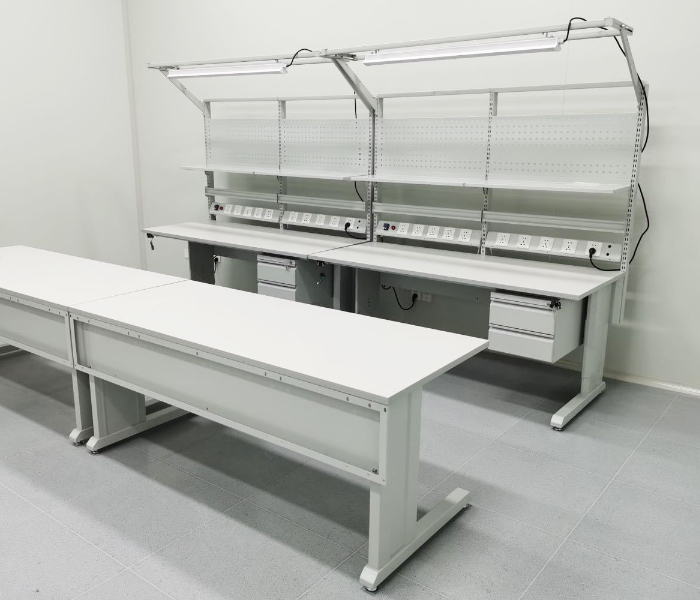 Compliance and risk control are the core advantages of the customizable ESD workbench. The grounding system resistance value can be precisely set between 10^6 and 10^9 ohms according to the ANSI/ESD S20.20 standard, and the humidity adaptability range is expanded to 30% to 70%. The integrated real-time monitoring system can collect 100 data points per second, control the static voltage fluctuation within ±10 volts, and reduce the probability of ESD events to less than 0.01%. Referring to the medical equipment recall cases in 2023, Johnson & Johnson reduced the scrap rate of precision sensors from 3% to 0.5% by customizing the temperature and humidity closed-loop control of workbenches, avoiding potential losses of over 5 million US dollars. This dynamic compliance mechanism has increased the audit pass rate by 40% and extended the maintenance cycle from six months to twelve months.
In terms of technological innovation, the customizable ESD workbench supports Internet of Things integration. Through RFID tool management, the material search time is reduced by 70%, and digital twin technology is utilized to simulate the production line layout, increasing the space utilization rate by 25%. The wind speed of the ion fan embedded in the workbench can be adjusted steplessly between 0.5 meters per second and 2.5 meters per second, with a neutralization time of less than 1 second and an accuracy of ±5 volts. As the practice of Siemens' digital factory has shown, after the customized workbench is integrated with the MES system, the efficiency of production data collection has increased by three times, and the accuracy rate of product traceability has reached 100%. This intelligent integration extends the equipment life cycle to 15 years, with an average time between failures (MTBF) exceeding 20,000 hours, redefining the value boundary of electrostatic protection.
Compliance and risk control are the core advantages of the customizable ESD workbench. The grounding system resistance value can be precisely set between 10^6 and 10^9 ohms according to the ANSI/ESD S20.20 standard, and the humidity adaptability range is expanded to 30% to 70%. The integrated real-time monitoring system can collect 100 data points per second, control the static voltage fluctuation within ±10 volts, and reduce the probability of ESD events to less than 0.01%. Referring to the medical equipment recall cases in 2023, Johnson & Johnson reduced the scrap rate of precision sensors from 3% to 0.5% by customizing the temperature and humidity closed-loop control of workbenches, avoiding potential losses of over 5 million US dollars. This dynamic compliance mechanism has increased the audit pass rate by 40% and extended the maintenance cycle from six months to twelve months.
In terms of technological innovation, the customizable ESD workbench supports Internet of Things integration. Through RFID tool management, the material search time is reduced by 70%, and digital twin technology is utilized to simulate the production line layout, increasing the space utilization rate by 25%. The wind speed of the ion fan embedded in the workbench can be adjusted steplessly between 0.5 meters per second and 2.5 meters per second, with a neutralization time of less than 1 second and an accuracy of ±5 volts. As the practice of Siemens' digital factory has shown, after the customized workbench is integrated with the MES system, the efficiency of production data collection has increased by three times, and the accuracy rate of product traceability has reached 100%. This intelligent integration extends the equipment life cycle to 15 years, with an average time between failures (MTBF) exceeding 20,000 hours, redefining the value boundary of electrostatic protection.
Compliance and risk control are the core advantages of the customizable ESD workbench. The grounding system resistance value can be precisely set between 10^6 and 10^9 ohms according to the ANSI/ESD S20.20 standard, and the humidity adaptability range is expanded to 30% to 70%. The integrated real-time monitoring system can collect 100 data points per second, control the static voltage fluctuation within ±10 volts, and reduce the probability of ESD events to less than 0.01%. Referring to the medical equipment recall cases in 2023, Johnson & Johnson reduced the scrap rate of precision sensors from 3% to 0.5% by customizing the temperature and humidity closed-loop control of workbenches, avoiding potential losses of over 5 million US dollars. This dynamic compliance mechanism has increased the audit pass rate by 40% and extended the maintenance cycle from six months to twelve months.
In terms of technological innovation, the customizable ESD workbench supports Internet of Things integration. Through RFID tool management, the material search time is reduced by 70%, and digital twin technology is utilized to simulate the production line layout, increasing the space utilization rate by 25%. The wind speed of the ion fan embedded in the workbench can be adjusted steplessly between 0.5 meters per second and 2.5 meters per second, with a neutralization time of less than 1 second and an accuracy of ±5 volts. As the practice of Siemens' digital factory has shown, after the customized workbench is integrated with the MES system, the efficiency of production data collection has increased by three times, and the accuracy rate of product traceability has reached 100%. This intelligent integration extends the equipment life cycle to 15 years, with an average time between failures (MTBF) exceeding 20,000 hours, redefining the value boundary of electrostatic protection.