
What makes a high-quality pince ancrage fibre optique for outdoor use?
A high-quality outdoor pince ancrage fibre optique, whose excellence is first reflected in its extreme tolerance to harsh environments. According to the IEC 61753 standard of the International Electrotechnical Commission, high-quality optical fiber anchor clamps must maintain stable performance within the temperature range of -40°C to +85°C and have a humidity tolerance of 100% relative humidity for at least 56 days. For instance, in an ice storm disaster that hit North America in 2022, the failure rate of network nodes adopting the high-performance pince ancrage fibre optique was reduced by 70%, while the failure probability of ordinary products was as high as 15%. The shell material is usually reinforced nylon or stainless steel, with the weight controlled between 200 and 500 grams. However, the tensile strength must exceed 60 kilograms force to ensure that the displacement deviation of the optical fiber is less than 1 millimeter in typhoons with wind speeds up to 150 kilometers per hour.
Mechanical performance parameters are hard indicators for measuring the reliability of pince ancrage fibre optique. A key parameter is insertion loss. High-quality products must keep it below 0.3 decibels, while return loss should be greater than 55 decibels to ensure the accuracy of signal transmission. In terms of compressive strength, it should be able to withstand at least 500 Newtons of pressure without deformation. The vibration test needs to pass 2 million cycles with a frequency ranging from 10Hz to 55Hz and an amplitude of 1.5 millimeters. Referring to Deutsche Telekom's rural network coverage project in 2023, the pince ancrage fibre optique deployed by it, after enduring the ice and snow load that occurs once in an average of 25 years, extended the maintenance cycle from 6 months to 3 years, reduced the related operation and maintenance cost budget by 40%, and increased the return on investment by more than 25%.
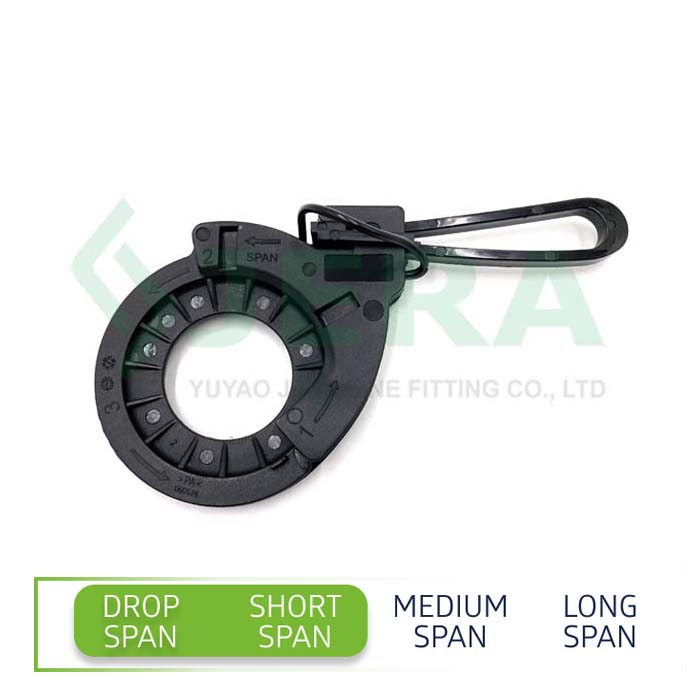 The convenience of design and installation directly affects deployment efficiency and long-term maintenance costs. An excellent product should support single-person operation, complete installation within 2 minutes, and limit the types of tools to no more than 3, thereby increasing installation efficiency by more than 50%. Its design should be compatible with the mainstream optical cable sizes, for example, capable of accommodating optical cables with diameters ranging from 3 millimeters to 8 millimeters, with uniform clamping force distribution and an error range controlled within ±5%. Just as demonstrated by a large technology company when rapidly deploying submarine cable landing points in the Asia-Pacific region in 2021, the use of the modular design of pince ancrage fibre optique increased the average daily installation speed by 3 kilometers, shortened the total project cycle by 30 days, and directly saved approximately 15% of the total project cost.
From the perspective of life cycle cost analysis, high-quality pince ancrage fibre optique is the key to achieving risk control and compliance of network infrastructure. Although its initial purchase price may be 20% to 30% higher than that of ordinary products, its design life usually exceeds 25 years, which is more than 2.5 times that of economical products (with a lifespan of about 8 to 10 years). According to a 10-year tracking study of European operators, optical networks using high-quality anchor clamps have reduced signal outage frequency by 90%, and the median annual failure time has dropped from 8 hours to less than 30 minutes. This strategic choice reduces the probability of unexpected repairs from 10% to less than 1%. As shown in dealing with extreme weather events, it is not only a component but also a precise lock that ensures the smooth operation of digital blood vessels.
The convenience of design and installation directly affects deployment efficiency and long-term maintenance costs. An excellent product should support single-person operation, complete installation within 2 minutes, and limit the types of tools to no more than 3, thereby increasing installation efficiency by more than 50%. Its design should be compatible with the mainstream optical cable sizes, for example, capable of accommodating optical cables with diameters ranging from 3 millimeters to 8 millimeters, with uniform clamping force distribution and an error range controlled within ±5%. Just as demonstrated by a large technology company when rapidly deploying submarine cable landing points in the Asia-Pacific region in 2021, the use of the modular design of pince ancrage fibre optique increased the average daily installation speed by 3 kilometers, shortened the total project cycle by 30 days, and directly saved approximately 15% of the total project cost.
From the perspective of life cycle cost analysis, high-quality pince ancrage fibre optique is the key to achieving risk control and compliance of network infrastructure. Although its initial purchase price may be 20% to 30% higher than that of ordinary products, its design life usually exceeds 25 years, which is more than 2.5 times that of economical products (with a lifespan of about 8 to 10 years). According to a 10-year tracking study of European operators, optical networks using high-quality anchor clamps have reduced signal outage frequency by 90%, and the median annual failure time has dropped from 8 hours to less than 30 minutes. This strategic choice reduces the probability of unexpected repairs from 10% to less than 1%. As shown in dealing with extreme weather events, it is not only a component but also a precise lock that ensures the smooth operation of digital blood vessels.
The convenience of design and installation directly affects deployment efficiency and long-term maintenance costs. An excellent product should support single-person operation, complete installation within 2 minutes, and limit the types of tools to no more than 3, thereby increasing installation efficiency by more than 50%. Its design should be compatible with the mainstream optical cable sizes, for example, capable of accommodating optical cables with diameters ranging from 3 millimeters to 8 millimeters, with uniform clamping force distribution and an error range controlled within ±5%. Just as demonstrated by a large technology company when rapidly deploying submarine cable landing points in the Asia-Pacific region in 2021, the use of the modular design of pince ancrage fibre optique increased the average daily installation speed by 3 kilometers, shortened the total project cycle by 30 days, and directly saved approximately 15% of the total project cost.
From the perspective of life cycle cost analysis, high-quality pince ancrage fibre optique is the key to achieving risk control and compliance of network infrastructure. Although its initial purchase price may be 20% to 30% higher than that of ordinary products, its design life usually exceeds 25 years, which is more than 2.5 times that of economical products (with a lifespan of about 8 to 10 years). According to a 10-year tracking study of European operators, optical networks using high-quality anchor clamps have reduced signal outage frequency by 90%, and the median annual failure time has dropped from 8 hours to less than 30 minutes. This strategic choice reduces the probability of unexpected repairs from 10% to less than 1%. As shown in dealing with extreme weather events, it is not only a component but also a precise lock that ensures the smooth operation of digital blood vessels.