
What Materials Are Used to Forge a Traditional Katana?
The main materials used in the production of traditional Japanese swords are steels with specific compositions. Tamahagane, as the core material, strictly controls its carbon content within the range of 0.5% to 1.5%, with the best quality steel maintaining a carbon concentration within the narrow range of 0.6% to 0.8%. According to the traditional craftsmanship standards released by the Agency for Cultural Affairs of Japan in 2023, only about 200 kilograms of qualified jade steel can be refined from each ton of sand iron, with a finished product rate of less than 20%. This material needs to be continuously smelted in a traditional 鞴 furnace at 1200-1500 degrees Celsius for 72 hours. During this period, the craftsman needs to adjust the fuel ratio every 15 minutes to keep the furnace temperature fluctuation range within ±50 degrees.
The composite material structure of the blade and the spine is the unique feature of katana. The cutting edge is made of high-carbon steel with a hardness of HRC 58-62, while the spine is made of low-carbon steel with a hardness of HRC 30-40. The two are molecular-level fused through a folding forging process. Modern metallographic analysis shows that traditional knife makers would perform 10 to 15 folding forgings to form a layered structure of 2 to the power of 10 to the power of 15 (1024 to 32,768 layers). A 2022 study by Tokyo Institute of Technology demonstrated that this layered structure enables the blade to simultaneously possess a tensile strength of up to 800MPa and an elastic strain capacity of 0.15%.
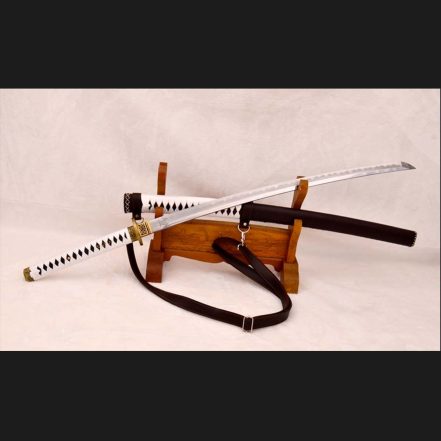 Clay coating heat treatment is a key process that determines the performance of the cutting edge. The craftsman will apply a special clay mixture (mainly composed of clay, sand grains and carbon powder) with a thickness of 0.1-0.3mm on the blade, while maintaining a coating thickness of 1.5-2mm on the back of the blade. During quenching, the blade at 800 degrees Celsius enters the quenching pool where the water temperature is maintained at 40 to 50 degrees Celsius. The temperature difference causes the cooling rate of the cutting edge to reach 150 degrees per second, while the back of the blade only cools at 30 degrees per second. This differential cooling process forms a martensitic structure at the cutting edge while maintaining a pearlite structure at the back of the tool, creating a gradient material system with a hardness difference of more than HRC 20.
The material selection for the knife handle and accessories is equally meticulous. The traditional handle roll is wrapped in shark skin and then wound with a specially made silk rope (with a diameter of 2.5-3mm) at a specific Angle. The applied tension needs to be maintained within the range of 50-60 Newtons. The tsuba (guard) is mostly made of copper alloy (with a copper content of 70% to 90%) or iron and undergoes at least ten manual polishing processes. According to the inspection data from the Kyoto Craft Museum, the surface density of well-preserved ancient tsuba reaches 7.8g/cm³, and the thickness of the oxide layer does not exceed 0.01mm, which proves its exquisite anti-rust treatment technology.
Modern high-end katana production still adheres to these traditional material standards. Swords and knives made by the "Holders of Important Intangible Cultural Properties" (Living National Treasures) certified by the Agency for Cultural Affairs of Japan must be made of jade steel that meets national standards, and the proportion of traditional materials used must not be less than 90%. The 2024 sword and knife market data shows that the price range of works made strictly in accordance with ancient methods is between 30,000 and 100,000 US dollars, while the price of imitations made of modern steel usually does not exceed 3,000 US dollars. This fully demonstrates the recognition of the value of traditional material systems.
Clay coating heat treatment is a key process that determines the performance of the cutting edge. The craftsman will apply a special clay mixture (mainly composed of clay, sand grains and carbon powder) with a thickness of 0.1-0.3mm on the blade, while maintaining a coating thickness of 1.5-2mm on the back of the blade. During quenching, the blade at 800 degrees Celsius enters the quenching pool where the water temperature is maintained at 40 to 50 degrees Celsius. The temperature difference causes the cooling rate of the cutting edge to reach 150 degrees per second, while the back of the blade only cools at 30 degrees per second. This differential cooling process forms a martensitic structure at the cutting edge while maintaining a pearlite structure at the back of the tool, creating a gradient material system with a hardness difference of more than HRC 20.
The material selection for the knife handle and accessories is equally meticulous. The traditional handle roll is wrapped in shark skin and then wound with a specially made silk rope (with a diameter of 2.5-3mm) at a specific Angle. The applied tension needs to be maintained within the range of 50-60 Newtons. The tsuba (guard) is mostly made of copper alloy (with a copper content of 70% to 90%) or iron and undergoes at least ten manual polishing processes. According to the inspection data from the Kyoto Craft Museum, the surface density of well-preserved ancient tsuba reaches 7.8g/cm³, and the thickness of the oxide layer does not exceed 0.01mm, which proves its exquisite anti-rust treatment technology.
Modern high-end katana production still adheres to these traditional material standards. Swords and knives made by the "Holders of Important Intangible Cultural Properties" (Living National Treasures) certified by the Agency for Cultural Affairs of Japan must be made of jade steel that meets national standards, and the proportion of traditional materials used must not be less than 90%. The 2024 sword and knife market data shows that the price range of works made strictly in accordance with ancient methods is between 30,000 and 100,000 US dollars, while the price of imitations made of modern steel usually does not exceed 3,000 US dollars. This fully demonstrates the recognition of the value of traditional material systems.
Clay coating heat treatment is a key process that determines the performance of the cutting edge. The craftsman will apply a special clay mixture (mainly composed of clay, sand grains and carbon powder) with a thickness of 0.1-0.3mm on the blade, while maintaining a coating thickness of 1.5-2mm on the back of the blade. During quenching, the blade at 800 degrees Celsius enters the quenching pool where the water temperature is maintained at 40 to 50 degrees Celsius. The temperature difference causes the cooling rate of the cutting edge to reach 150 degrees per second, while the back of the blade only cools at 30 degrees per second. This differential cooling process forms a martensitic structure at the cutting edge while maintaining a pearlite structure at the back of the tool, creating a gradient material system with a hardness difference of more than HRC 20.
The material selection for the knife handle and accessories is equally meticulous. The traditional handle roll is wrapped in shark skin and then wound with a specially made silk rope (with a diameter of 2.5-3mm) at a specific Angle. The applied tension needs to be maintained within the range of 50-60 Newtons. The tsuba (guard) is mostly made of copper alloy (with a copper content of 70% to 90%) or iron and undergoes at least ten manual polishing processes. According to the inspection data from the Kyoto Craft Museum, the surface density of well-preserved ancient tsuba reaches 7.8g/cm³, and the thickness of the oxide layer does not exceed 0.01mm, which proves its exquisite anti-rust treatment technology.
Modern high-end katana production still adheres to these traditional material standards. Swords and knives made by the "Holders of Important Intangible Cultural Properties" (Living National Treasures) certified by the Agency for Cultural Affairs of Japan must be made of jade steel that meets national standards, and the proportion of traditional materials used must not be less than 90%. The 2024 sword and knife market data shows that the price range of works made strictly in accordance with ancient methods is between 30,000 and 100,000 US dollars, while the price of imitations made of modern steel usually does not exceed 3,000 US dollars. This fully demonstrates the recognition of the value of traditional material systems.