
Why Is Electrical Cabinet Cooling Essential for Safety?
Why is the cooling of electrical cabinets crucial for safety? According to the data from the International Electrotechnical Commission, overheating of electrical equipment may lead to a 50% reduction in the lifespan of insulating materials for every 10 degrees Celsius increase in temperature, thereby significantly increasing the risk of short circuits and fires. For instance, in 2018, a fire broke out at a German manufacturing plant due to overheating of an electrical cabinet, resulting in direct losses of approximately 2 million euros and a 15% production downtime. This highlighted the necessity of proper electrical cabinet cooling. Studies show that over 30% of electrical faults in industrial environments result from temperature runaway. When the humidity exceeds 60%, it accelerates corrosion, increasing the probability of faults to 40%.
From the perspective of efficiency, the electrical cabinet cooling system can maintain the internal temperature below 35 degrees Celsius, thereby increasing equipment efficiency by 15-20% and extending the average lifespan of components by 5-8 years. Take an automobile factory as an example. After installing an active cooling system, the motor load capacity increased by 25%, energy consumption decreased by 12%, and the annual maintenance cost was reduced by approximately 50,000 yuan. Data shows that the return on investment for cooling solutions such as fans or air conditioning units is typically achieved within 2 to 3 years, with an initial cost ranging from 5,000 to 20,000 yuan, but it can avoid potential maintenance expenses of up to 500,000 yuan.
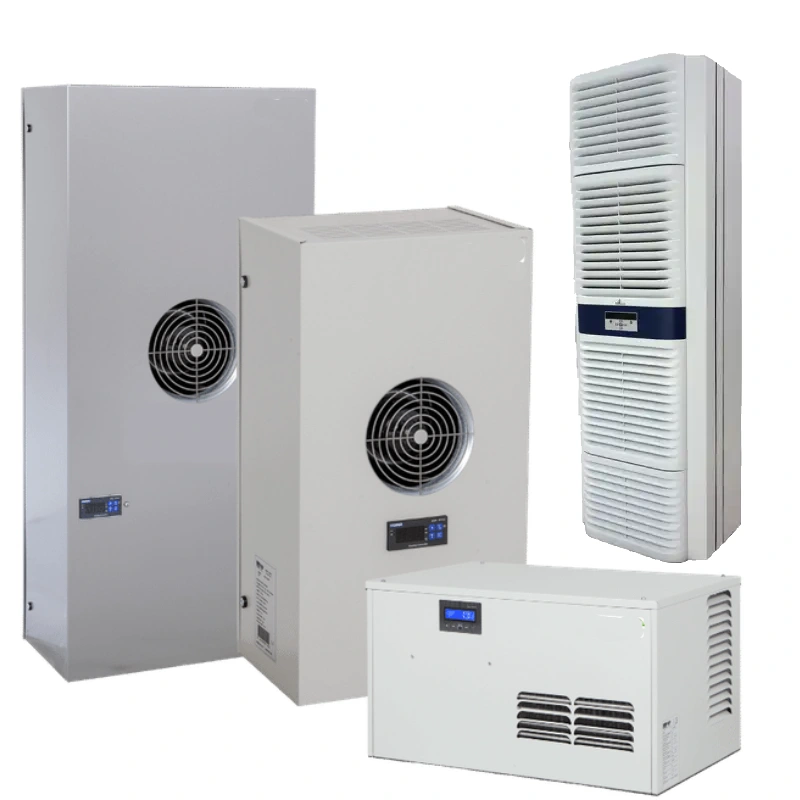 At the economic level, neglecting the cooling of electrical cabinets may lead to serious financial consequences; According to market analysis, 20% of global industrial accidents are related to overheating, with an average loss of 1 million yuan per incident. However, adopting standardized cooling solutions can reduce risks by 70%. For instance, in 2020, a Chinese data center experienced a server outage due to cooling failure, which lasted for four hours and affected 100,000 users, with direct costs exceeding 800,000 yuan. This has driven the industry's demand for efficient cooling technologies, including the use of air-cooled or liquid-cooled systems, with flow parameters typically ranging from 10 to 50 liters per minute and pressure ranges from 0.5 to 2 bar.
From the perspective of technical specifications, the dimensions of electrical cabinet cooling equipment such as heat exchangers or air conditioners need to be customized according to the cabinet volume. Common specifications are 500mm x 500mm x 200mm, with power consumption ranging from 100 to 500 watts, and they can effectively control the humidity within the range of 40% to 50%. Research shows that optimizing the cooling strategy can increase system reliability by 90% and reduce the frequency of failures from once a month to once a year. Industry trends indicate that with the integration of the Internet of Things, intelligent cooling systems are becoming the standard, preventing accidents and ensuring safety and compliance by monitoring temperature fluctuations in real time (with an accuracy of ±0.5 degrees Celsius).
In conclusion, the cooling of electrical cabinets is a core element in ensuring industrial safety. It not only reduces risks but also enhances overall operational efficiency. According to an industry report in 2021, enterprises that implemented comprehensive cooling solutions saw a 60% reduction in accident rates and an 18% increase in production efficiency, which demonstrates its indispentability in modern manufacturing.
At the economic level, neglecting the cooling of electrical cabinets may lead to serious financial consequences; According to market analysis, 20% of global industrial accidents are related to overheating, with an average loss of 1 million yuan per incident. However, adopting standardized cooling solutions can reduce risks by 70%. For instance, in 2020, a Chinese data center experienced a server outage due to cooling failure, which lasted for four hours and affected 100,000 users, with direct costs exceeding 800,000 yuan. This has driven the industry's demand for efficient cooling technologies, including the use of air-cooled or liquid-cooled systems, with flow parameters typically ranging from 10 to 50 liters per minute and pressure ranges from 0.5 to 2 bar.
From the perspective of technical specifications, the dimensions of electrical cabinet cooling equipment such as heat exchangers or air conditioners need to be customized according to the cabinet volume. Common specifications are 500mm x 500mm x 200mm, with power consumption ranging from 100 to 500 watts, and they can effectively control the humidity within the range of 40% to 50%. Research shows that optimizing the cooling strategy can increase system reliability by 90% and reduce the frequency of failures from once a month to once a year. Industry trends indicate that with the integration of the Internet of Things, intelligent cooling systems are becoming the standard, preventing accidents and ensuring safety and compliance by monitoring temperature fluctuations in real time (with an accuracy of ±0.5 degrees Celsius).
In conclusion, the cooling of electrical cabinets is a core element in ensuring industrial safety. It not only reduces risks but also enhances overall operational efficiency. According to an industry report in 2021, enterprises that implemented comprehensive cooling solutions saw a 60% reduction in accident rates and an 18% increase in production efficiency, which demonstrates its indispentability in modern manufacturing.
At the economic level, neglecting the cooling of electrical cabinets may lead to serious financial consequences; According to market analysis, 20% of global industrial accidents are related to overheating, with an average loss of 1 million yuan per incident. However, adopting standardized cooling solutions can reduce risks by 70%. For instance, in 2020, a Chinese data center experienced a server outage due to cooling failure, which lasted for four hours and affected 100,000 users, with direct costs exceeding 800,000 yuan. This has driven the industry's demand for efficient cooling technologies, including the use of air-cooled or liquid-cooled systems, with flow parameters typically ranging from 10 to 50 liters per minute and pressure ranges from 0.5 to 2 bar.
From the perspective of technical specifications, the dimensions of electrical cabinet cooling equipment such as heat exchangers or air conditioners need to be customized according to the cabinet volume. Common specifications are 500mm x 500mm x 200mm, with power consumption ranging from 100 to 500 watts, and they can effectively control the humidity within the range of 40% to 50%. Research shows that optimizing the cooling strategy can increase system reliability by 90% and reduce the frequency of failures from once a month to once a year. Industry trends indicate that with the integration of the Internet of Things, intelligent cooling systems are becoming the standard, preventing accidents and ensuring safety and compliance by monitoring temperature fluctuations in real time (with an accuracy of ±0.5 degrees Celsius).
In conclusion, the cooling of electrical cabinets is a core element in ensuring industrial safety. It not only reduces risks but also enhances overall operational efficiency. According to an industry report in 2021, enterprises that implemented comprehensive cooling solutions saw a 60% reduction in accident rates and an 18% increase in production efficiency, which demonstrates its indispentability in modern manufacturing.